⚠️ Disclosure: This article contains affiliate links. If you sign up through our link, we may earn a commission at no extra cost to you. Full disclosure →
If you have watched enough anime, you know the sound instantly — that bright, slightly breathy, sing-song anime voice that seems to belong to a species of person who does not exist in your own country. This article breaks down what that moe voice actually is: not a genetic accident, but a trained performance register with real roots in Japan’s voice-acting industry. Then I will tell you the honest part — where you can hear that register live and unscripted, and why plenty of viewers end up preferring the opposite.
The Anime Voice Is a Performance, Not a Birth Defect
Let me get the biggest misconception out of the way first, because it shapes everything else. A lot of Western viewers assume the high, cute anime voice is simply how Japanese women sound. It is not. It is a register — a way of speaking that a person switches into and out of, the same way you switch into a different voice when you answer a work call versus when you talk to a dog.
There is actual research pointing this direction. Comparative studies of pitch across languages have repeatedly found that Japanese women, on average, speak at a noticeably higher pitch than women speaking European languages, and — this is the interesting bit — that Japanese-English bilingual women tend to raise their pitch when they switch into Japanese and lower it when they switch back. Bilingual men in those same studies did not show the same shift. If pitch were purely anatomical, that would be impossible. The same larynx cannot be one height in English and another height in Japanese.
So what is going on is cultural and behavioral: in a Japanese-speaking context, a higher, softer pitch tends to be read as feminine, warm, approachable, non-threatening. Speakers who want to project that read pick it up, often without consciously deciding to. It is learned, and — crucially for what follows — it can be learned deliberately, refined, and performed at a professional level.
That is exactly what happened in anime.
Seiyuu Culture: How Japan Turned Voice Into a Career Track
In most countries, voice acting is a side gig for actors who mainly do something else. In Japan, seiyuu (声優, “voice actor”) is its own profession with its own training pipeline, its own agencies, its own fanbase, and its own celebrity tier. That structural difference is the single biggest reason the anime voice exists as a polished, repeatable thing rather than a happy accident.
The lineage goes back further than anime. Japan’s first voice-only performers came out of radio drama in the 1920s, and public broadcasters were running formal training programs for radio actors by the 1940s. By the late 1970s, dedicated voice-actor training schools and audio-only productions had grown to the point where someone could build an entire full-time career on voice work alone, without belonging to a stage theater company first.
■ What that training actually produces
Because it is a real profession, it has real curriculum. Training tends to cover breath support and vocal stamina — recording sessions can run brutally long — plus emotional range, microphone technique, and, very much to the point here, genre-specific character registers. A working seiyuu is generally expected to be able to produce a bright high-pitched “cute” delivery for one kind of role and drop into a low, rough delivery for another, on request, take after take.
Think about that for a second. The anime voice is not something a person is. It is something a trained performer does, the way a session guitarist can play country on one track and metal on the next. That reframe is the whole point of this article, and it also, I think, makes the whole thing more impressive rather than less.
■ The feedback loop with fans
Then the loop closes. Seiyuu in Japan are public figures — they do concerts, radio shows, live events, character-song releases. Fans learn the individual performers, not just the characters. Which means the register itself became something audible outside the screen, something people could recognize, imitate, and aspire to. A generation of Japanese kids grew up hearing that register performed live on stage by people whose names they knew. It stopped being “how cartoons sound” and became a style you could learn.
What the Moe Voice Is Actually Made Of
“High-pitched” is the lazy description, and it is only about a quarter of the story. When you break the register down, it tends to be a stack of several things happening at once.
■ Pitch — and more importantly, pitch movement
Yes, the baseline is raised. But the tell is the contour. The moe register tends to use wide, quick melodic swoops within a single short phrase — up on the stressed part, a little drop, a lift again at the end. Flat delivery at a high pitch just sounds thin and slightly robotic. The musicality is what makes it read as “cute” rather than “shrill.”
■ Breathiness
A touch of air in the tone. Not whispering — that is a different thing entirely — just a softer, less pressed vocal quality that takes the hard edge off consonants. Breathiness generally reads as intimacy and softness across a lot of languages, which is part of why the register travels so well to listeners who do not speak a word of Japanese.
■ Sentence-ending particles
This one is genuinely Japanese-specific and it is doing an enormous amount of work. Japanese sentences frequently end in short particles that carry emotional coloring rather than dictionary meaning — think of the little trailing ne, yo, na, kana sounds you have heard ten thousand times without knowing what they were. They function roughly as tone-of-voice made into actual syllables: seeking agreement, softening an assertion, adding warmth or uncertainty.
Because they sit at the very end of a phrase, they are the perfect place to hang a melodic flourish on. A performer can stretch one, lift it, soften it, add a tiny laugh to it. English mostly has to do this work with intonation alone; Japanese hands the speaker a dedicated syllable to decorate. If you want more on the written cousins of these — the emoji, kaomoji, and slang that carry the same emotional coloring in text — I broke that down in decoding Japanese chat slang, kaomoji, and emoji.
■ The rhythm of the language itself
Japanese is generally described as mora-timed rather than stress-timed like English — very roughly, the beats come out more evenly spaced instead of clustering around stressed syllables. Whatever the precise phonetic accounting, the practical effect for a listener is that Japanese speech tends to have a steadier, more even pulse. That regular pulse is a great bed for melodic play on top of it. It is easier to sing over a metronome than over a jazz drummer.
■ Vocabulary and word choice
The register is not only sound. It typically comes with softer word choices, more diminutive and playful phrasing, more filler sounds of agreement, more small reactive noises. You can technically produce the acoustic register while saying something cold, and it sounds bizarre — like a mismatch. The package works because sound and content agree.
Why Anime Fans in Particular Get Hit So Hard by It
Here is the part I find genuinely interesting. If you have watched a few hundred hours of subtitled anime, you have done something unusual: you have spent a very large number of hours listening to a language you do not speak, while reading emotional content off the screen.
What that trains is a strong association between this specific vocal register and emotional payoff. You have heard that voice attached to confessions, to comfort scenes, to characters you cared about, over and over, for years. Your brain has built a shortcut. The sound arrives pre-loaded with feeling before any meaning is even processed.
That is not a weird or embarrassing thing — it is exactly how film scoring works, how a specific accent can make you homesick, how a song from when you were seventeen still gets you. It is just that anime fans have accidentally trained the association with unusual intensity, because we did it for hours a night without translation as a crutch for the audio.
Which sets up the thing this whole article is building toward.
Recorded Line vs. Live Voice: The Difference Nobody Warns You About
An anime line is a finished object. It was written by someone, approved by someone, recorded across multiple takes, edited, mixed, and aimed at everyone. It is beautiful, and it is broadcast — one signal, millions of receivers, none of them specifically you.
A live voice is a different category of experience entirely. On a live chat platform, when someone is speaking in that bright, warm register, three things are true that are never true of a recording:
It is unscripted. The little pauses, the false starts, the laugh that arrives half a beat early — none of that survives an edit booth, and all of it is evidence that a real person is on the other end assembling sentences in real time.
It is responsive. The register shifts based on what you do. She types or says something, you react, and the pitch moves. That closed loop is the entire difference. A recording cannot notice you.
It uses your name. Or your handle, or whatever you go by. A performed register aimed at a general audience and the same register aimed at one identified person are not the same signal, even when the acoustics are identical.
This is where the distinction between this article and my earlier one matters. I have written separately about the whisper and ASMR side of Japanese voice — the quiet, close-to-the-mic, calming end of the spectrum. The moe register is nearly the opposite pole: bright rather than hushed, energetic rather than soothing, playful rather than tender. Some performers do both and switch between them depending on the mood. Many specialize in one and never touch the other.
If you want to hear the bright register live without committing money first, the DX LIVE free trial gives you enough to sample a few rooms and figure out which end of the spectrum actually does something for you. Ten points is not a lot, but it is plenty to answer the “is this my thing or not” question. You can sign up free here and just listen for a while.
The Honest Flip Side: Plenty of People Do Not Want This At All
I am not going to sell you the idea that every Japanese woman on a live chat platform sounds like a light-novel heroine, because that is simply not true and you will find out within about ten minutes.
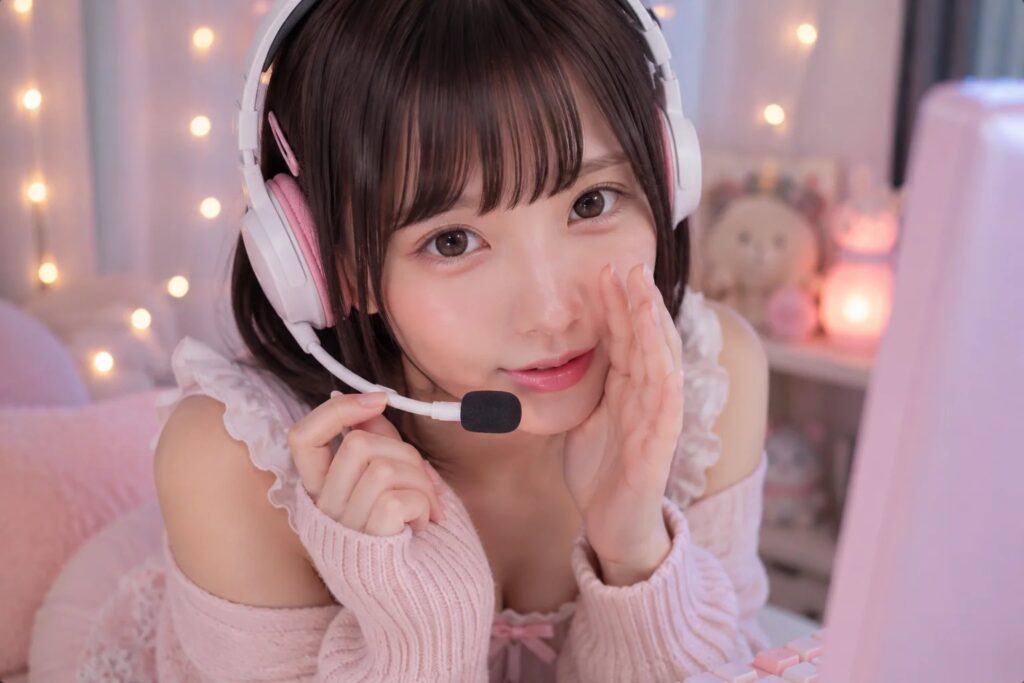
Most models use their normal speaking voice. The full moe register is a specialty. Some performers lean into it as their whole brand — often ones with a cosplay or anime-adjacent presentation. Most others just talk like adults talk: a normal mid-range voice, normal pacing, no performance layer at all.
A lot of viewers actively prefer the natural voice. This comes up constantly and it is a completely legitimate taste. A lower, calmer, unperformed voice reads as more genuine to many people, and once you have noticed that a register is a performance, some listeners cannot un-notice it — at which point the charm evaporates and it starts to feel like being sold to. I would honestly put myself somewhere in the middle: I enjoy the bright register in short doses and find a natural low voice better for a long conversation.
Sustained high-register performance is tiring. Anime recording happens in takes with breaks. A live session runs continuously. A performer holding a heightened register for a long stretch is doing real physical work, and it is normal for the voice to drift toward neutral over a long session. That is not her dropping a mask on you — it is just what a human voice does.
Do not treat it as a request you are owed. Asking someone to perform a specific voice on demand is asking for labor. Some performers are delighted to and it is literally their advertised specialty; others will find it awkward. Read the room, and if the bright register is specifically what you came for, look for the people who are clearly already offering it rather than trying to convert someone who is not.
How to Actually Find and Enjoy the Register on a Live Platform
■ Look for the presentation, not the description
Performers who work in the moe register usually signal it visually and thematically — costume-forward presentation, anime-adjacent room decor, brighter styling. The register almost always travels with the aesthetic, because they are part of the same act.
■ Judge on sound, not on profile text
Profile text on Japanese platforms is written in Japanese and machine translation flattens exactly the nuance you are trying to detect. Skip it. Drop into a free area, listen for thirty seconds, and move on if it is not the sound you want. Your ears are a much better filter than a translated bio.
■ Use headphones, and mind your levels
The bright register lives in the upper mids, which is precisely the range that cheap laptop speakers turn harsh. On speakers it can sound piercing; on decent headphones it sounds warm and detailed. Same voice, completely different impression. Also, start your volume lower than you think you need — this register has more dynamic range than a whisper track does.
■ Learn five words and use them
You do not need Japanese to enjoy the sound, but a couple of short reactions in Japanese will get you noticeably more warmth back, and warmth is what the register runs on. I put together a short practical list in simple English words and phrases that actually work on DX LIVE — the same principle applies in reverse. Small effort, disproportionate return.
■ Listen for the switch
Once you know the register is a performance, the most interesting moment in any session is the transition — the point where someone drops out of the bright voice into their natural one because they laughed for real, or got surprised, or forgot for a second. Personally I think that moment is better than either voice on its own. It is the one thing a recorded anime line structurally cannot give you.
The Short Version
The anime voice is a craft, not a coincidence. It sits on top of a genuine cross-linguistic tendency for Japanese to be spoken at a higher pitch in feminine registers, gets refined into a professional skill by a voice-acting industry that has had formal training pipelines for the better part of a century, and gets its distinctive musicality from features that are baked into the Japanese language itself — sentence-ending particles you can decorate, and an even rhythmic pulse you can play melody over.
If you are an anime fan, you have spent years building an emotional shortcut to that sound. Hearing it live, unscripted, and pointed at you specifically is a fundamentally different experience from hearing it in a finished recording — not because it is more real, but because it is responsive. And if it turns out you prefer a natural low voice instead, that is a perfectly good answer too. You will only find out by listening.
Ready to Try DX LIVE?
The fastest way to find out whether the anime register does anything for you is to hear it live instead of reading about it. DX LIVE is the largest Japanese-language live chat platform, and the free trial is enough to sample a few rooms and let your ears decide.
No talking required: DX LIVE has free chat rooms where you just enter and watch the live stream without spending points. No typing, no mic, no Japanese. Signing up is free and takes no credit card.
⚠️ Disclosure: This article contains affiliate links. If you sign up through our link, we may earn a commission at no extra cost to you. Full disclosure →